
A comprehensive training for those who wish to grow a Brazilian Zouk dance community
Designed for those who teach or wish to teach Brazilian Zouk, and those who build or intend to start building a dance community.
Join us in Washington DC from June 27 through July 2 for our second edition of our District Zouk Professional Development Week (DZPDW) — a 30+ hour professional development course designed to help teachers and community leaders improve their craft by:
developing new teaching skills,
learning about curriculum building and class planning,
improving their personal dance skills through drills, challenges, and exercises,
learning about student attraction and retention, and
understanding the key elements for community growth and development.
During DZPDW, you’ll gain access to decades of combined community-building and teaching experience. District Zouk alone has been growing the Brazilian Zouk community in the DMV area of the United States for over 11 years. Today, District Zouk offers 13 classes a week, Monday through Thursday; more than any other school in the USA.
Our team of instructors is known nationally and internationally for excellence in their craft. By joining DZPDW, you’ll receive valuable information that has been tested, applied, and refined over the years.
You'll be able to take the DZPDW virtually and get access to our content from wherever you are! More details about our Online option below.
A Practical Approach
What to do, when, how, for how long, and according to your circumstances.
DZPDW blends clear teaching theory with lots of practice. Everything we'll share are tools and systems we actively use in our progressive class program—week after week. These tools have been tested in real classes, observed with real students, and recalibrated repeatedly based on what actually improves learning, retention, and community growth.
DZPDW guides you through practical aspects of teaching and running a Brazilian Zouk community, such as:
attracting and retaining new dancers,
planning a syllabus and progression,
designing different class formats and knowing when to use each
When you join our program, you won’t just hear “what works.” By joining the full program, you’ll have the chance to see how we implement these tools in our regular progressive classes, and you’ll learn the decisions behind them—what we do, how we do it, and why.
Who is this training for?
This training is designed for experienced dancers who already run and/or teach in a local dance community or intend to start offering classes.
Our goal is to provide community leaders, or soon-to-be community leaders, with the tools we find important for your success.
This course is not intended for those who wish to learn Brazilian Zouk from scratch or learn more advanced material. It's truly about teaching -- for those who want to teach and already have solid experience with Brazilian Zouk.
The Schedule
30 hours of content - not counting the breaks
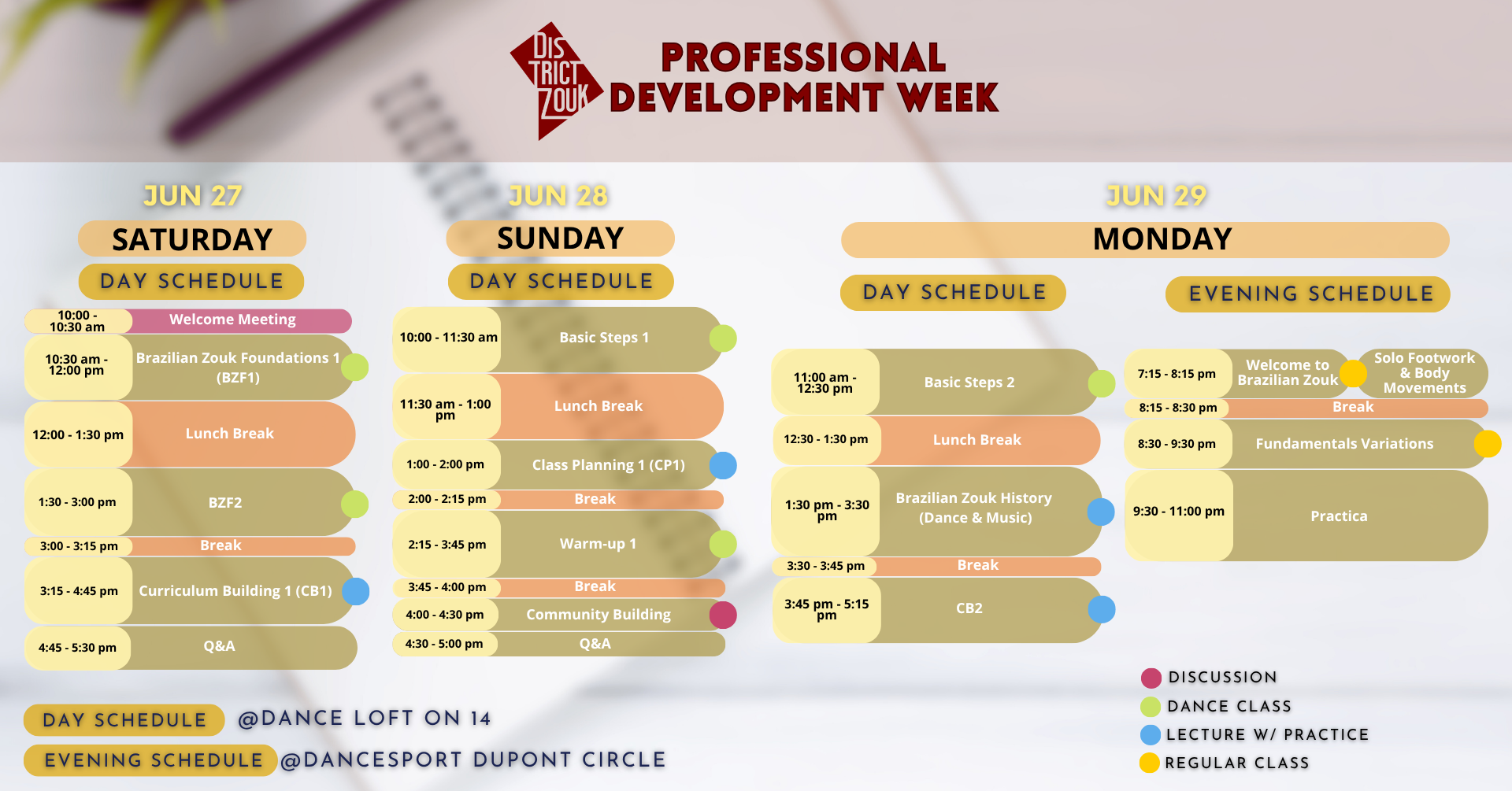
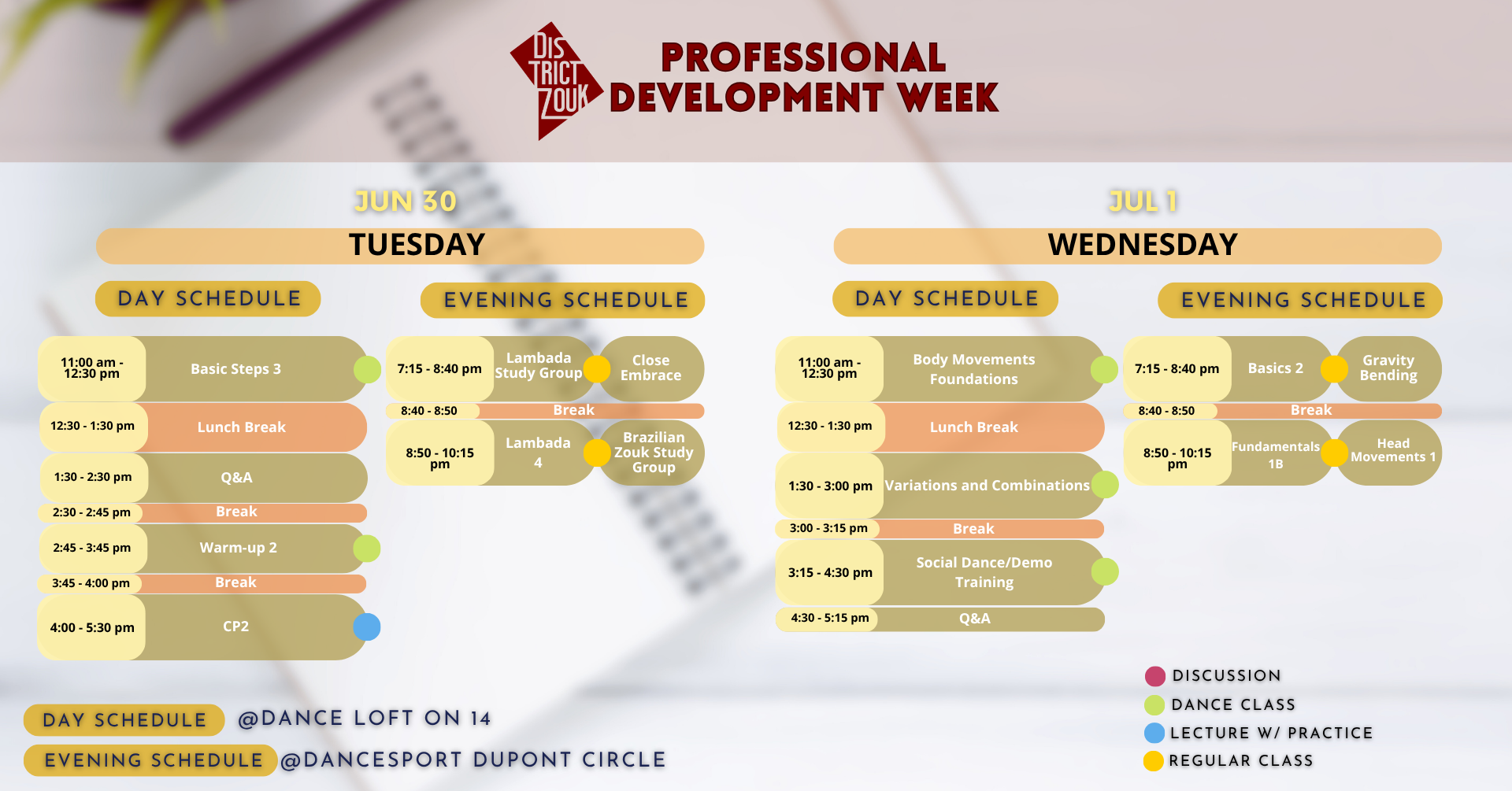
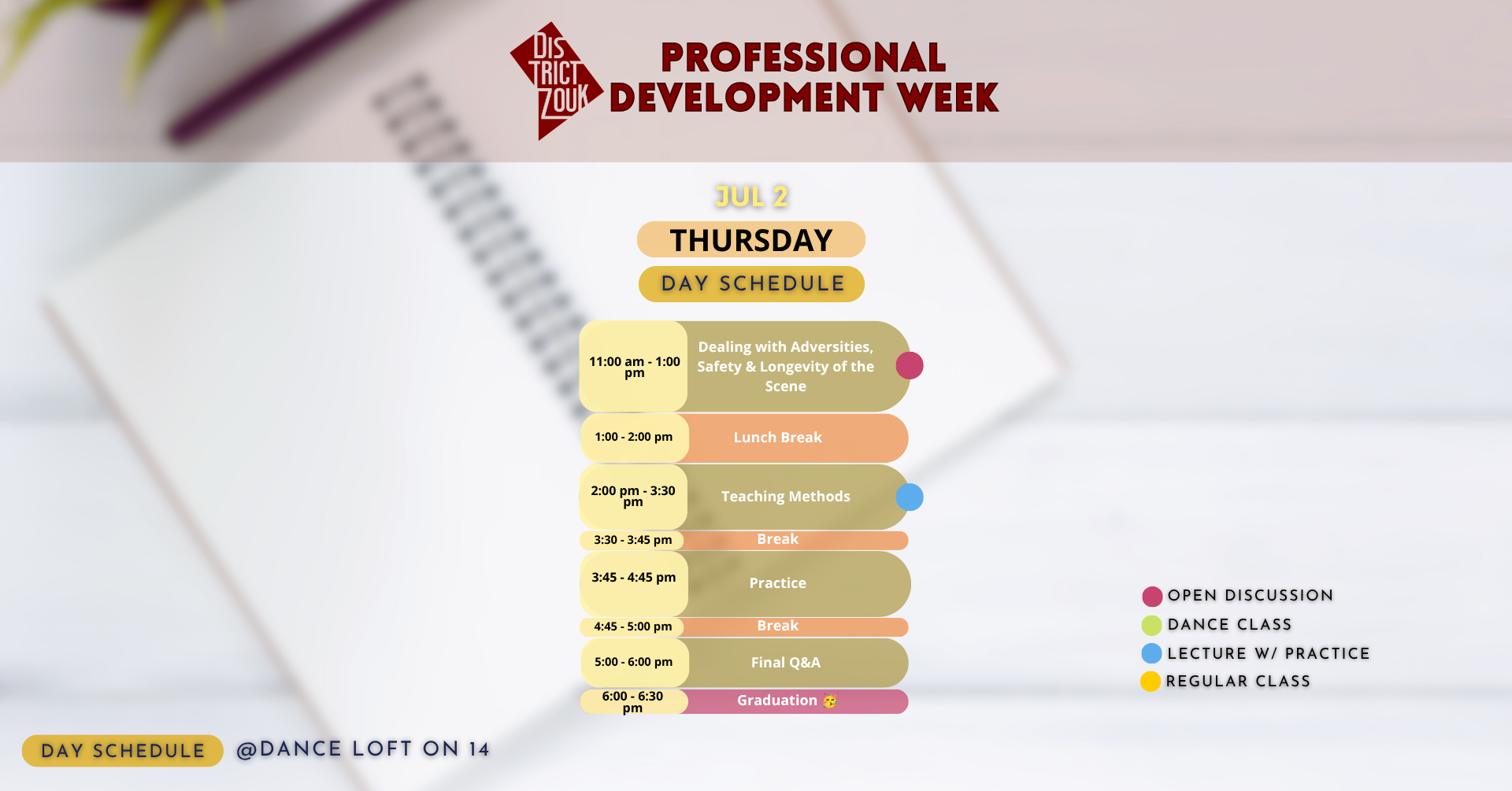
Our schedule combines a variety of classes:
- Discussion - here we open the floor to discuss important topics for community building;
- Dance Class - our practical classes, where we present the content and experiment right away;
- Lecture w/ Practice - the classes that are part lecture, part practical. We first present the theory, then materialize it.
- Regular Class - our regular drop-in and progressive classes. Participants who take the full program will be able to participate and/or observer our regular classes.
More details about each class of the DZPDW will be released soon.
Our Online Option
Be present at the training from wherever you are and get access to the recordings for a whole year.
We know it can be hard to take a week off a week of work to be present at the training in Washington, DC.
For that reason, we're also offering an Online Option to the DZPDW 2026. You'll learn live and get access to the recordings for a year after the training concludes.
By choosing the Online Option, you'll able to participate in the full Day Schedule - our core training - and, of course, as questions during our Q&As.
Check out the pricing for the Online Option Below.
What will you get out of this training?
By the end of the DZPDW, you will:
-
Understand better the culture behind Brazilian Zouk is, where it came from, and what makes it Brazilian
-
Know the elements that lead to the growth of a community and what can lead to stagnation or contraction
-
Know how to lay out and develop a syllabus that teaches Brazilian Zouk in an easy and accessible way
-
Understand the elements of an efficient and engaging dance class
-
Have a deeper understand of the Brazilian Zouk foundations and basic steps, allowing you to better explain them, showcase them, and create interesting variations
Pricing
You can join us only for the dedicated program or the full program
Dedicated Program - Day Schedule
Our 30-hour training from Jun 27 to July 2 - includes:
- our Day Schedule training classes,
- Sunday Social on Jun 28
- our Monday Practica on Jun 29
PRICE
Lot 1 (until 4/15 or when lot sells out) - $975
Lot 2 (until 5/15 or when lot sells out) - $1,015
Lot 3 (until 6/15 or when lot sells out) - $1,055
Lot 4 (after) - $1,100
Full Program (add-on) - Evening Schedule
Add-on option to be able to participate in our regular classes June 29 to July 1.
When you sign up for our Full Program, you get the chance to experience the content shared during the day in practice by participating in our regular classes either as a student in rotation or as an observer, depending on which class you would like to take part in and the number of people in class.
During DZPDW, we'll have classes from Monday to Wednesday, which includes our drop-in lessons on Monday and 8 of our regular progressive series on Tuesday and Wednesday.
Includes:
- Participation in both classes June 29
- Participation in one class in rotation and one as an observer on each night June 30 and July 1
PRICE
Lot 1 (until 4/15 or when lot sells out) - $125
Lot 2 (until 5/15 or when lot sells out) - $135
Lot 3 (until 6/15 or when lot sells out) - $145
Lot 4 (after) - $155
Online Option - Day Schedule
Our 30-hour training from Jun 27 to July 2.
Join us Online live for the core portion of the training.
PRICE
Lot 1 (until 6/15) - $425
Lot 2 (after 6/15) - $450
District Zouk in numbers
In 2025 alone,
-
we had 850+ people attending our events and 5,300+ tickets sold across all offerings
-
we averaged 100+ students in our progressive series cycles
-
we averaged 90+ people in our regular socials, reaching over 110 by the end of the year
-
our student's attendance was of 85% during our progressive series
-
we offered 5 full 8-week cycles of progressive classes, over 37 courses